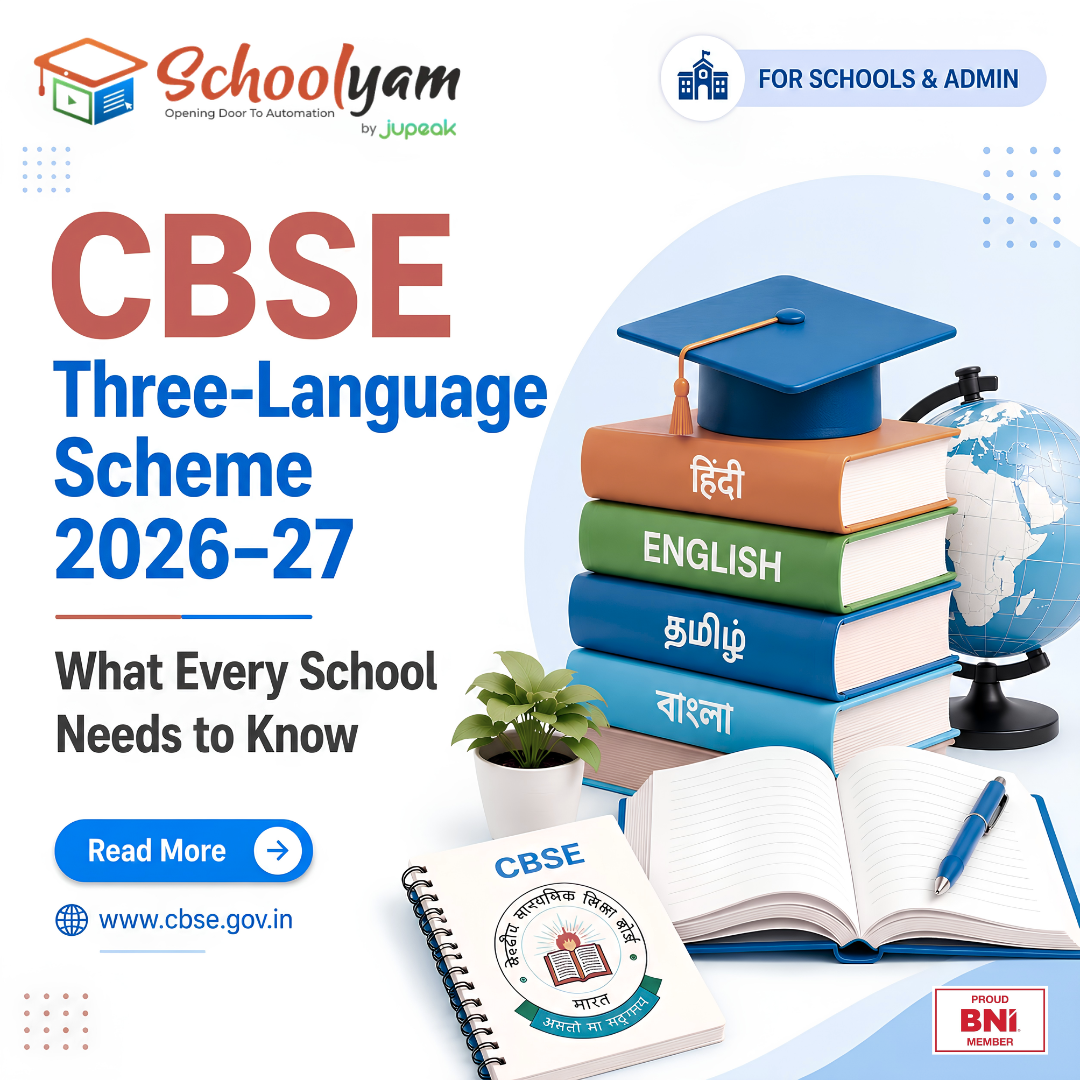
The Central Board of Secondary Education (CBSE) has released comprehensive guidelines for implementing the Three-Language Scheme in all affiliated schools from the Academic Session 2026–27.
The move is in line with the National Education Policy (NEP) 2020, which encourages multilingual education while ensuring that learning remains engaging and student-friendly.
The new policy aims to strengthen Students’The policy aims to strengthen students’ multilingual abilities while promoting holistic development.
What is the Three-Language Scheme?
Under the new guidelines, Students may opt for a foreign language such as French, German, Arabic, or Spanish only if the other two selected languages are Bhartiya Bhashas.
For example:
- Hindi + Tamil + English
- Marathi + Sanskrit + French
- Telugu + English + Kannada
Students can choose a non-native language like English, French, German, Arabic, or Spanish as the third language only if the other two are Indian languages.
What Changes for Different Classes?
Class X Students (2026–27)
Students studying in Class X during the academic session 2026–27 will continue with the existing two-language system.
No third language is required for this batch.
Class IX Students (2026–27)
Students entering Class IX will study three languages.
Some important points include:
- The third language (R3) will be assessed through an internal school-based assessment.
- There will not be a separate CBSE Board Examination for R3 in Class X.
- However, students must successfully complete the school assessment to receive the CBSE Secondary School Examination Pass Certificate.
- Students who do not qualify initially will get another opportunity before the declaration of Class X results.
Students in Classes VII & VIII
Students currently studying in Classes VII and VIII will continue with three languages when they move to secondary classes.
Those who are already studying two non-native languages have been given a one-time relaxation and will only need to add one Bhartiya Bhasha.
Students in Class VI
The policy will be implemented fully for students entering Class VI from 2026–27 onwards.
Unlike the transitional batches, These students will follow the complete Three-Language Scheme as they progress to the secondary stage, including the applicable assessment framework in Class X.
Important Exemptions
CBSE has also announced exemptions for certain categories:
- Children with Special Needs (CwSN) will receive relaxations as per the RPwD Act, 2016.
- CBSE schools located outside India are exempt from the compulsory Indian third language.
- Foreign students returning to India are also exempt from studying a Bhartiya Bhasha as the third language.
Support for Schools
Understanding that schools may face challenges in implementing the policy, CBSE has introduced several support measures.
Schools can:
- Use existing teachers with language proficiency.
- Appoint qualified teachers, retired educators, postgraduate language experts
- Share teachers through Sahodaya clusters, or
- Conduct hybrid and virtual language classes.
Additionally, NCERT has already started publishing R3 Language Learning Resources and textbooks on its official website to help schools and students prepare effectively.
Conclusion
The Three-Language Scheme marks another important step towards implementing NEP 2020 and promoting multilingual education across India.
While the policy introduces new language-learning opportunities, CBSE has also ensured transitional relaxations and school-based assessments to make implementation smoother for both schools and students.
School leaders, Teachers, Parents, and Students should carefully understand these New Guidelines to ensure a smooth transition from the 2026–27 Academic Session.
Follow Schoolyam for the latest CBSE Updates, Policy Changes, Examination Guidelines, and important Announcements to keep your School informed and Future-ready!
CBSE Three-Language Scheme 2026–27: What Every School Needs to Know.